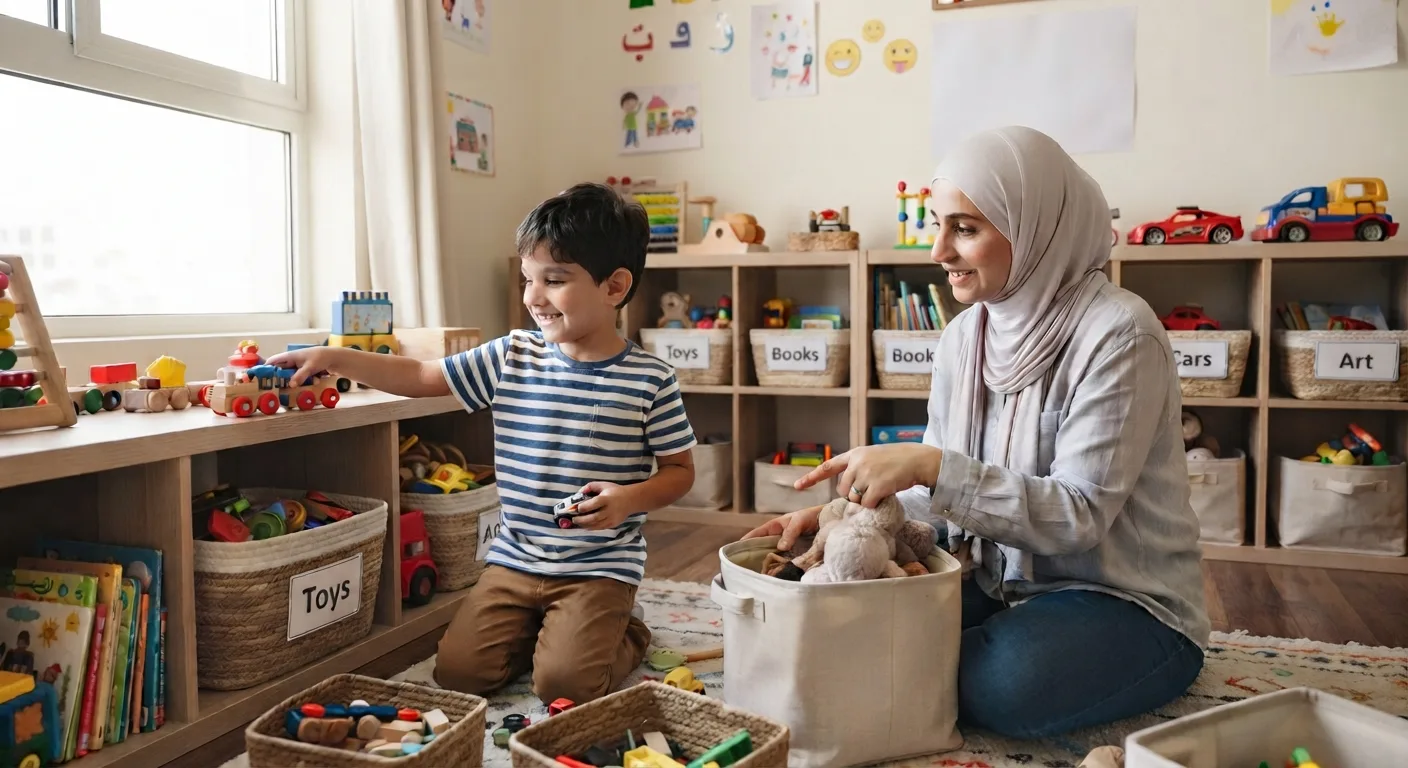
A child might look at a room full of toys and not know where to start. They might start gathering a few toys, then get distracted and go back to playing, or ask, "Where should I put them?", or wait for us to tidy up for them.
Therefore, teaching a child to tidy up their toys and belongings is not just about cleanliness or obedience; it is a daily opportunity to learn important skills such as organization, planning, following steps, and starting and finishing a task.
The goal is not for the child to become tidy overnight, but rather to gradually learn how to organize things around them and take part in their daily responsibilities with greater independence.
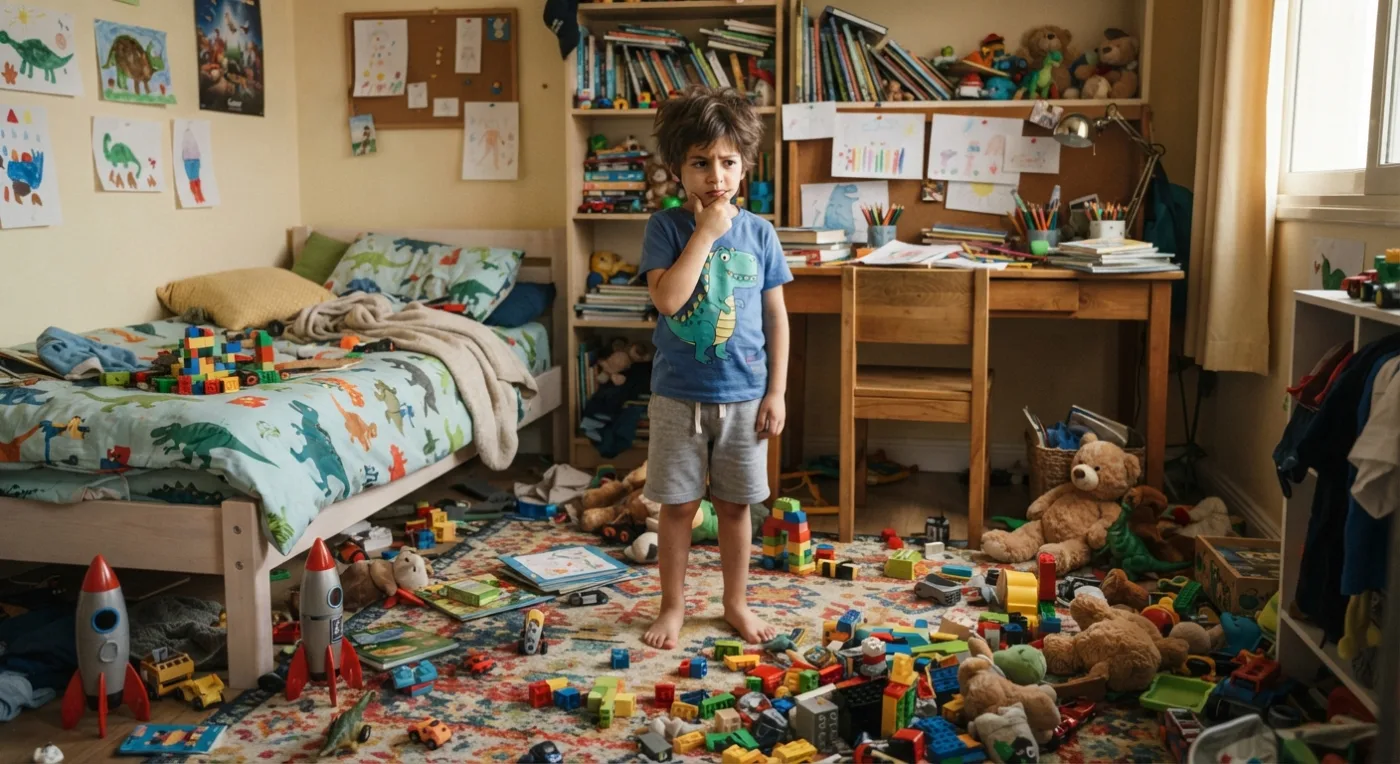
When can we start teaching a child to tidy up their toys?
There is no single age at which all children should start tidying up their toys, and we shouldn't compare one child to another. However, we can begin teaching the skill of organizing around the age of two with very simple tasks that suit the child's abilities. A young toddler might participate by putting a single toy into the box with a parent's help, and then gradually learn to gather a small group of toys and return them to their place. As they grow older, we can increase the number of steps and the level of responsibility required of them.
Start by asking: What part of the task can my child do right now? And what is the next step they can learn?
The goal is not for the child to tidy the entire room from the beginning, but rather for their ability to participate, organize, and develop independence to grow gradually.
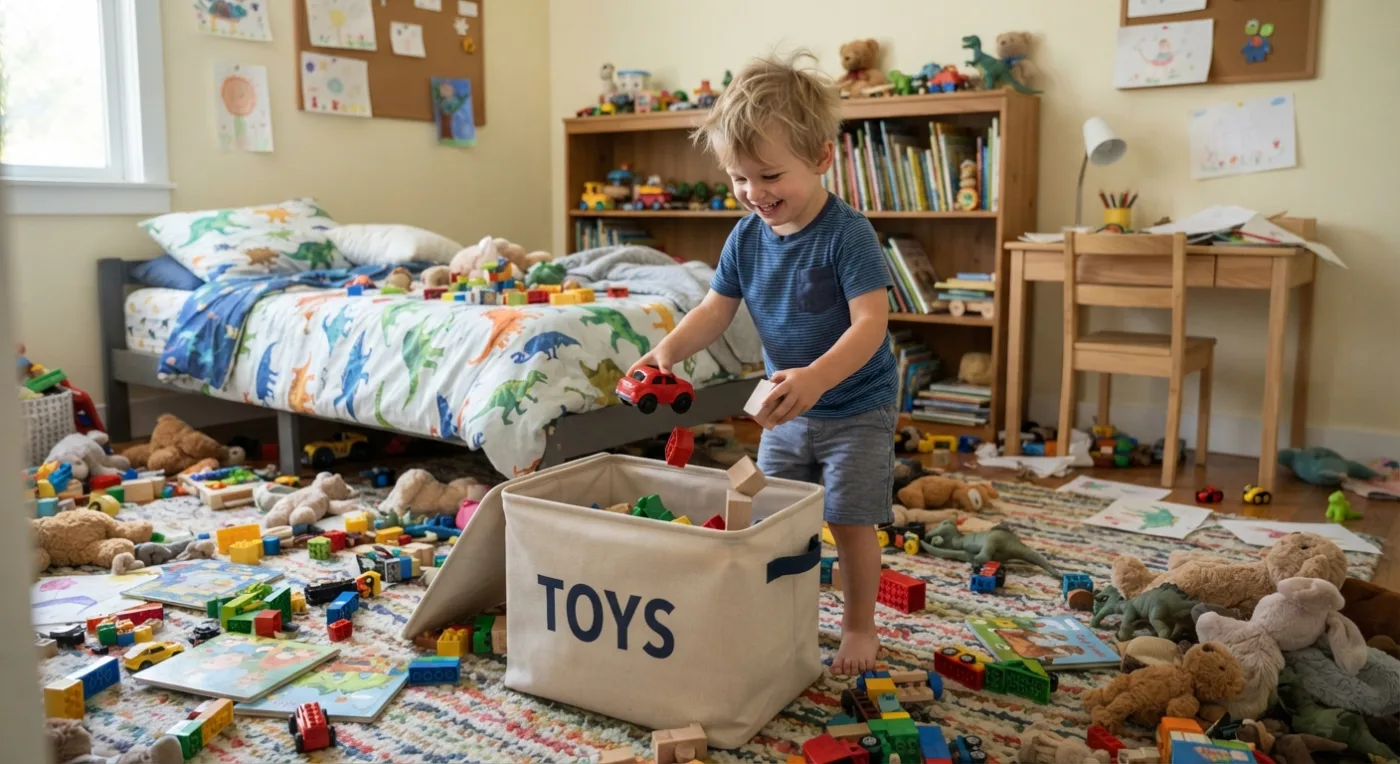
Why might a child find tidying up their toys difficult?
When we tell a child, "Tidy up your toys," we are actually asking them to perform several steps at the same time:
- To stop playing
- To pay attention to the things scattered around them
- To decide what to collect first
- To categorize things or know where they belong
- To move them to their places
- To remember where to put everything
- To keep going until the tidying is finished
From an occupational therapy perspective, we do not view a daily task in isolation from the skills a child needs to accomplish it. Tidying toys requires a set of motor, cognitive, and executive functions—such as attention, working memory, planning, sequencing, problem-solving, and motor control.
These skills do not all develop at the same time. Therefore, if a child needs constant reminders or does not know where to start, the problem might not be that they don't want to tidy up. The task itself might simply be greater than their current ability to organize its steps.
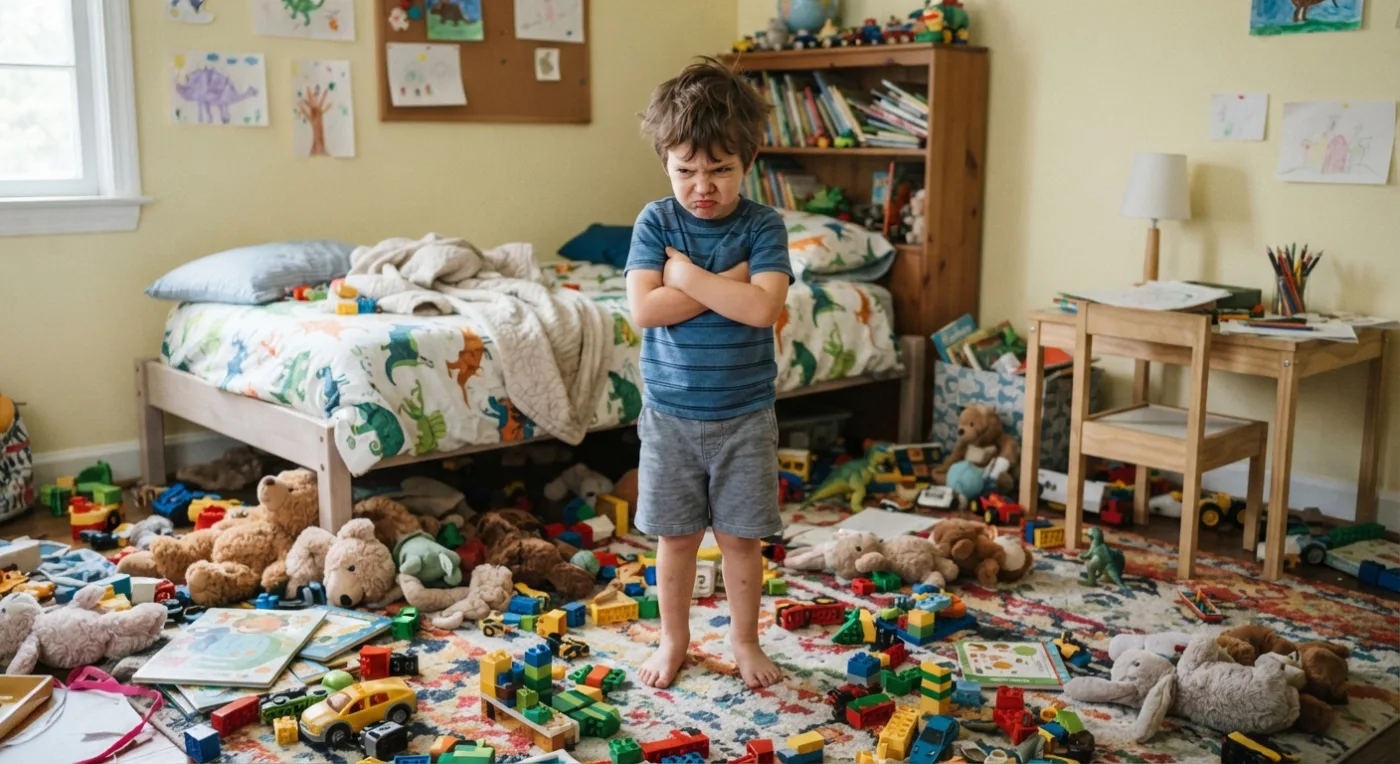
Start with small tasks instead of: tidy up everything!
The bigger and more unclear a task is, the harder it is to start. Instead of saying: "Tidy up the whole room," we can say: "Let's collect the cars first."
And after finishing collecting the cars: "Now let's put them in the box." After that, we move on to another group.
In this way, the child learns that a big task can be broken down into small, actionable steps.
With repetition, we can begin to reduce help and let the child determine the next step on their own.
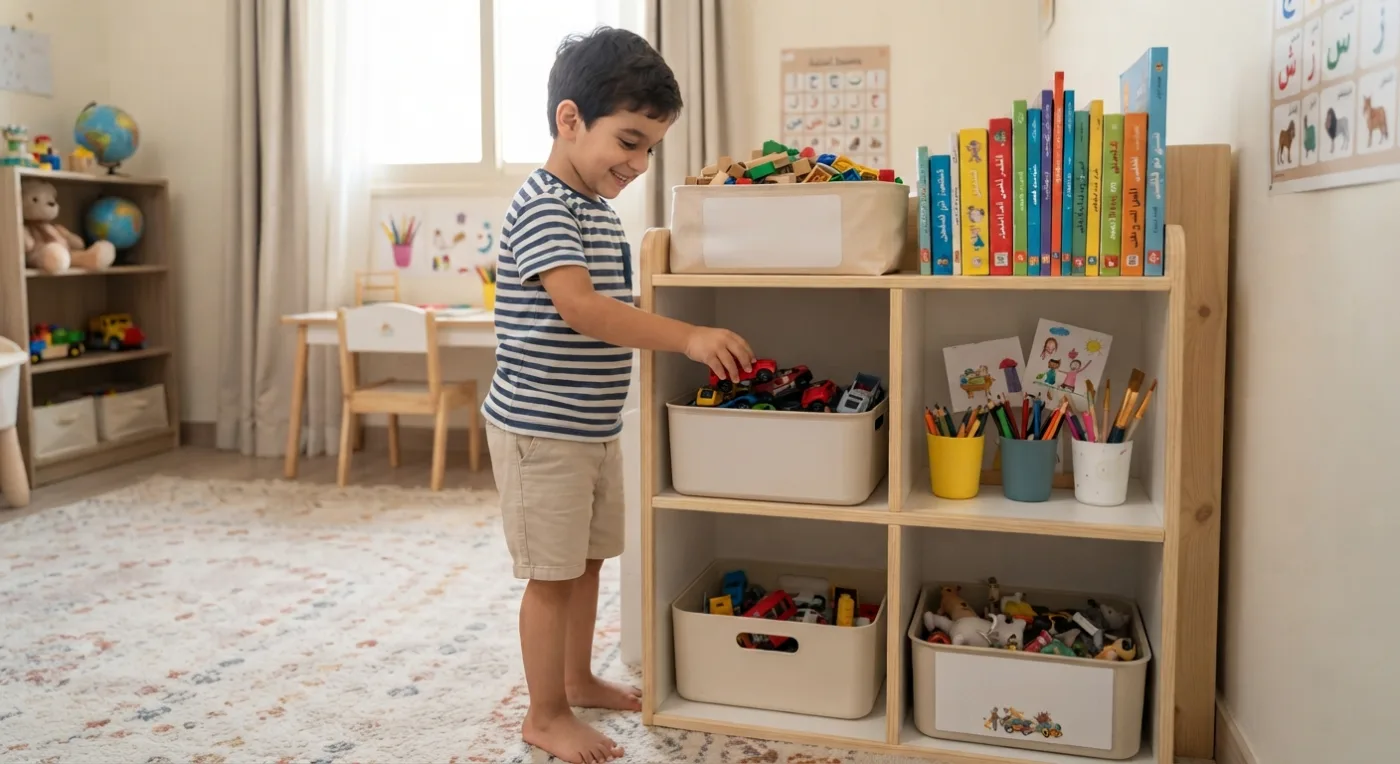
Give everything a clear place
It is hard to ask a child to keep things neat if they do not know where to put their belongings.
Each group can have a designated place, for example:
- A basket for cars.
- A box for blocks.
- A shelf for books.
- A fixed spot for crayons/colors.
- A box for small toys.
For younger children, simple pictures or symbols can be used on the boxes to show what is inside them.
From an occupational therapy perspective, modifying the environment is an important part of making it easier for a child to perform a task. Instead of relying solely on reminding them what to do, we can make the environment itself help them figure out what to do and where to put things.
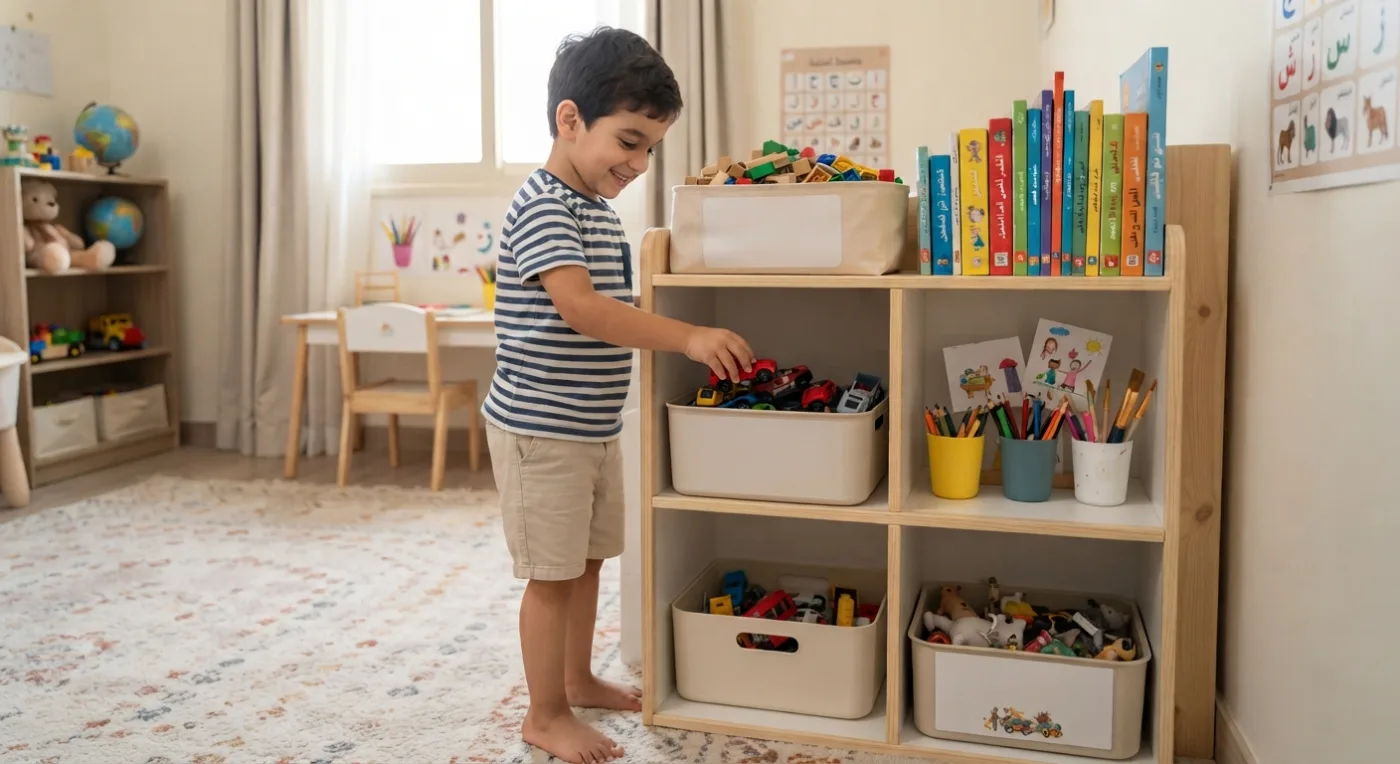
Limit the number of toys available at once
Sometimes the problem is not with the child, but with the environment.
Having too many toys in front of the child can make choosing what to play with and tidying up much more difficult.
We can keep a portion of the toys stored away and make only a limited set available at a time. This makes playing clearer and tidying up the space afterwards easier. The simpler the environment, the easier it is for the child to practice organization.
Give actionable instructions for the child
Long instructions can be difficult for a child, especially if they are still learning how to organize the steps of a task.
Instead of: "Come on, tidy up your toys, put the cars in their box, the blocks in their place, the books on the shelf, and then come over."
We can start with one step: "Collect the cars." Then: "Put them in the box." Then we move on to the next step.
As the child gains the skill, we can increase the number of steps they can perform without help
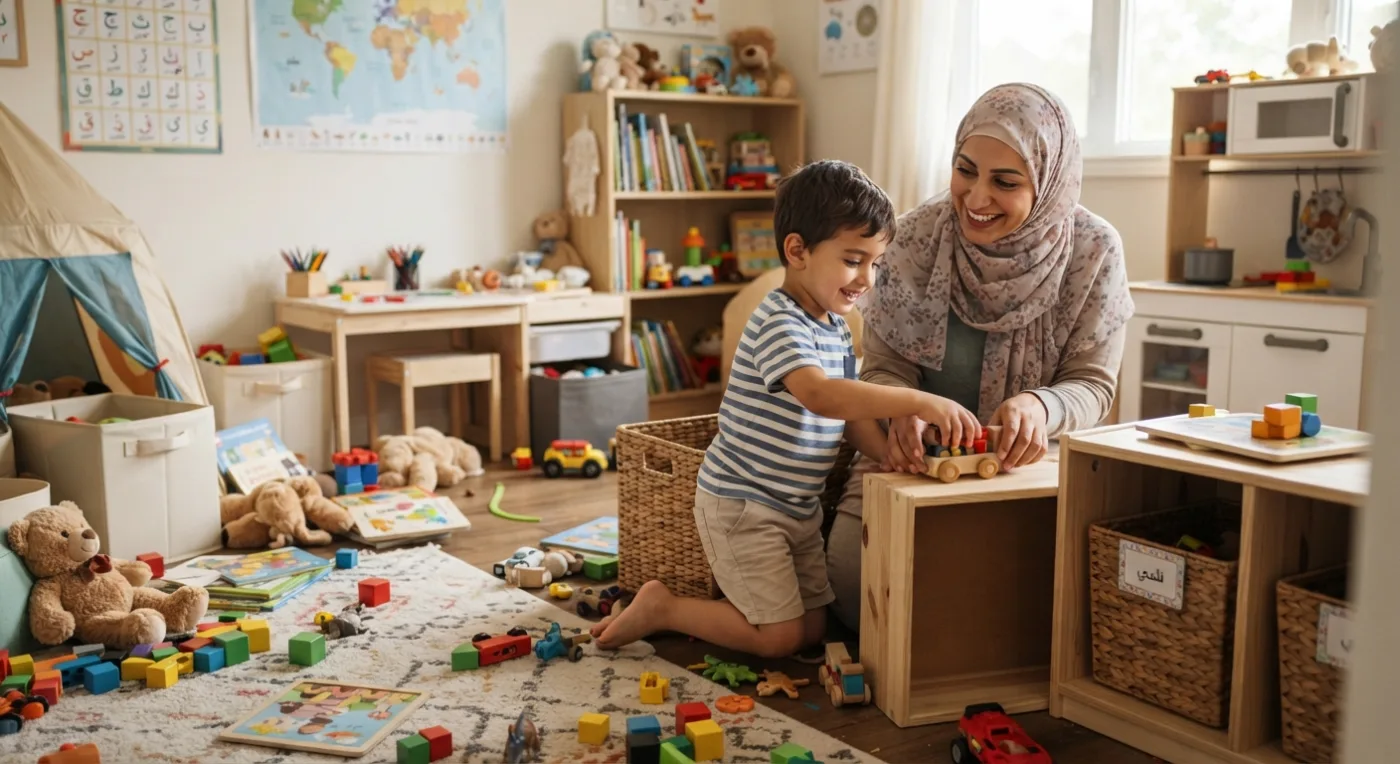
Teach them how to begin the task
Sometimes the hardest step is the beginning.
If a child stands in front of a room full of belongings and doesn't know what to do, we don't necessarily need to repeat the command in a louder voice.
We can help them by asking: "What is the first thing we want to collect?"
Or: "Where is the car box?"
In this way, we help the child think about the next step instead of doing the task for them.
Make tidying up part of the routine
It is easier to build a habit when it has a fixed time and sequence suited to the child's age and ability.
For example: we play, then we finish playing, then we tidy up the toys, then we move on to the next activity.
Alternatively, a fixed phrase can be used, such as: "Before we start a new game, we put the old toy back in its place."
With repetition, tidying up becomes an expected part of the activity rather than a sudden demand that follows it.
Don't do the whole task for them
When a child is slow, it might be easier to say: "Never mind, I'll tidy it up." This happens often, especially when we are in a hurry.
However, if our goal is to build independence, we can provide only the help they need and then gradually reduce it.
We might start by gathering the toys with them, then let them put them in the box, and after a while, limit our help to reminding them of the first step.
The goal is for the child to gradually learn how to complete the task on their own, rather than getting the tidying done as quickly as possible.
What if the child refuses to tidy up?
A child's refusal doesn't always mean they are irresponsible. They might be tired, enjoying their play and not wanting to transition, not knowing how to start, or feeling that the task is too overwhelming.
Before getting caught in the cycle of: repeating the command, then shouting or threatening, and finally parents doing the tidying up—try making the transition clearer: "We have five minutes left before we finish playing."
Then: "Playtime is over and it's time to tidy up, let's start with the cars."
And if the child needs help, you can break down the task instead of turning tidying into a daily battle.
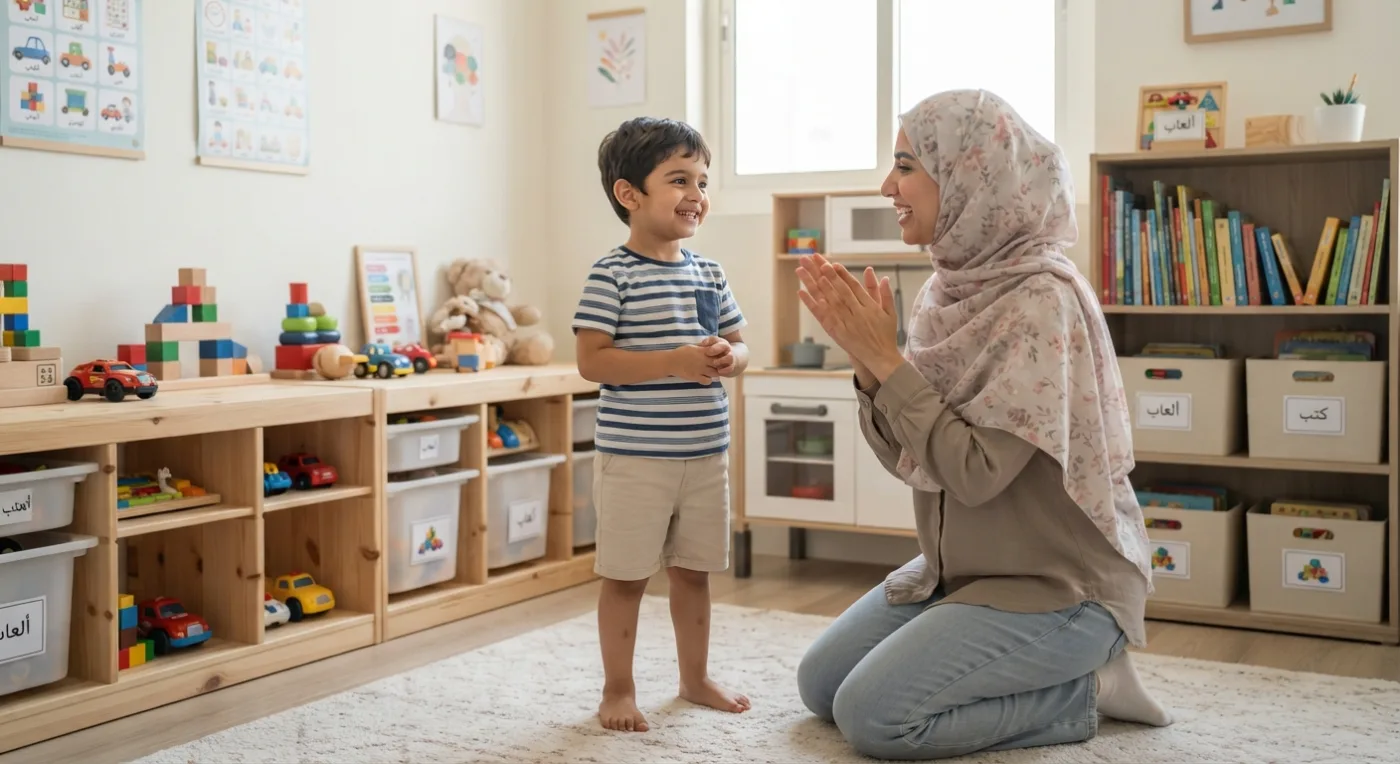
Praise the effort and process, not just the final outcome
Instead of saying: "Good job, the room is neat."
We can say:
"Champion, you knew where to start."
"You remembered where the cars go."
"Today you tidied the blocks all by yourself."
In this way, we help the child notice the skill they used, such as planning, remembering, organizing, and independence.
Organizing is a skill that is built with practice
Teaching a child to tidy up their toys does not mean we expect them to keep a flawless room. It is a daily opportunity to learn skills much bigger than just tidying:
How to start a task.
How to break it down into steps.
How to categorize and organize things.
How to remember where things belong.
How to finish what they started.
And how to take on age-appropriate responsibility.
These skills are built gradually through small tasks that the child can understand and execute, after which we increase the responsibility progressively as their abilities develop.
Therefore, we do not teach a child organization by yelling at them to be organized, but rather through daily practice: a clear task, small steps, an easy-to-understand environment, a fixed place for belongings, instructions suited to their ability, and repetition that helps them gradually gain independence.
Every time a child puts a toy back in its place, decides where to start, or completes a step without being reminded, they are not just tidying the room; they are practicing skills they will need later on to organize their school bag, prepare their belongings, and complete their daily tasks with greater independence.
What can we expect of the child?
Organization doesn't appear out of nowhere when a child grows up; we build it with them through the small tasks they experience every day. A young child may need direct participation from parents, while an older child can carry out several steps on their own.
Therefore, it is best to ask: What step can my child do right now? And how can I help them learn the next step?
Here, an occupational therapy perspective can be useful because it looks at the task, the child, and the environment together, rather than focusing solely on the child's behavior.
If there is a clear and persistent difficulty with a number of daily tasks, or if the child finds it very hard to follow steps, plan, use their hands, or transition between activities, it may be helpful to consult an occupational therapist to understand the skills affecting their daily performance
Hana Barakat
Occupational therapist